





Sunderland Street
1. The Dunstan Times Building 1866
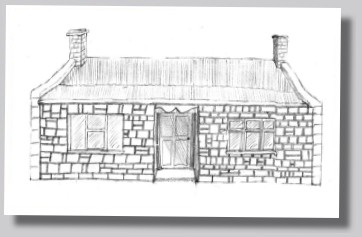
Clyde was the birthplace of the Goldfields Press with the publication on December 30, 1862, of the Dunstan News printed in a sun-dried brick shed on a site facing the river. The office shifted to its present site when a permanent building of iron with a wooden façade was built in 1866.
About this time the four-page paper was renamed the Dunstan Times. Owners and editors changed over the years until 1900, when 21 year-old Harold “Had” Stevens, son of the local schoolmaster, took over the weekly publication in partnership with E.J. Hill. Two years later his brother Syd bought Mr Hill’s shares and the Stevens family published the paper until 1948 when local newspapers merged to become the Central Otago News.
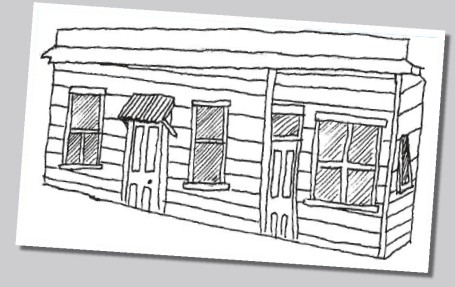
The little stone cottage (next on the right) was built in the early 1860s.It was the home of Mr Rae, known locally as Tinker Rae. He used it to display his wares when he was not peddling them around the district. Some years later a midwife lived in the cottage using the front room for “confinements”. There were no maternity hospitals then and most women gave birth in their homes, but some did use the midwife’s service.
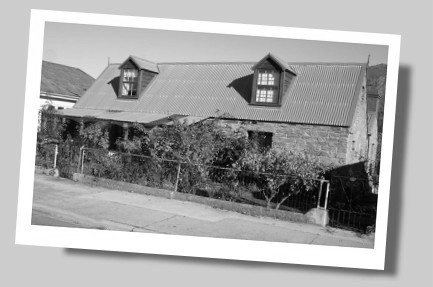
3. Dr Morice's home and "tent" hospital
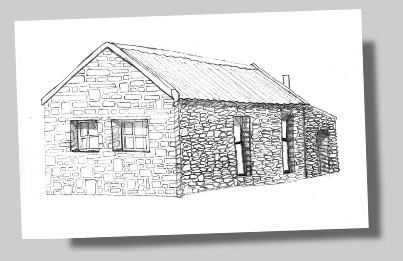
Sharing the large section of Tinker’s Cottage is the stone home built for Dr Morice in the early 1860s. He arrived in the Dunstan in 1863 and was so appalled seeing men suffering from frostbite, malnutrition and associated illnesses that he set up a tent hospital around his dwelling. His patients were mainly miners he found on the mining claims or on the street, many of whom were taken in for treatment. The top storey of the house is a modern addition.
The house next door belonged to James Hazlett, an early arrival in the Dunstan mining scene. In 1863 he set up a butcher’s shop in a front room of the house and then a small store in a corner of his section. He also ran a number of packhorses which carried goods to neighbouring mining sites.
James Hazlett served as Mayor of Clyde from 1868 until 1872 and then represented the Dunstan on the Otago Provincial Council until 1875. A keen churchman, hospital board member, and sports advocate, he owned a fine stable of horses housed in stone buildings along the rear of his section as well as a coach house across Miners Lane on the riverbank. Mr Hazlett instigated the first horse race meetings in Central Otago at Dunstan on December 31, 1862, and on New Year’s Day, 1863. The races were held on the south bank of Muttontown Gully (on the main road to Alexandra) and attracted racehorses from Moutere, Galloway and Earnscleugh Stations.
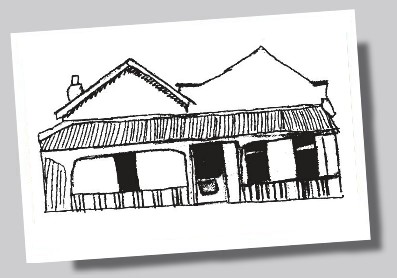

This stone building is possibly the first single-storied hotel built in Clyde, but the badly planned interior later led to it being condemned as a public house. It was owned by an Irishman, James Parks, whose staff included a housekeeper, cook and barman. The establishment specialised in egg dishes which were served up boiled, baked or scrambled for breakfast, dinner and tea, using eggs from hundreds of James’ hens running about the riverbank. However, neither his cooking nor his menu was praised, although he was a popular host. The hotel also catered for boarders.
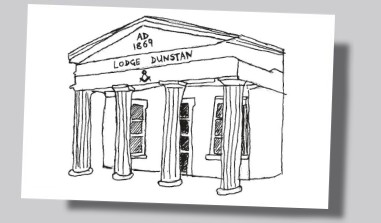
6. The Clyde Town Hall - Masonic Lodge 1869
Opposite, is the Dunstan Masonic Lodge, an impressive building of local stone with a plaster cladding. The unusual design featuring Doric pillars supporting the pediment and windows was the work of Mason and Clayton of Dunedin and built by J. Over under the watchful eye of Vincent Pyke, the Provincial Grand
Master, who laid the footstone on April 16, 1869. A cavity below the foundation stone contains a bottle sealed with the Grand Master’s ring, scrolls, copies of the Otago Daily Times, Dunstan Times and some coins. The silver trowel, made by a local silversmith (Barlow) and used to lay the mortar, is on display in the Clyde Historical Museum. The building cost £800 ($1600).
Unfortunately the Masons ran out of money before it was finished so it was sold to the municipality of Clyde for use as the town hall and the Masons were given the
right to hold their meeting there.
It was consecrated as a Lodge Room attended by 39 members on October 21, 1869, and marked by a grand ball held in the hall. The Athenaeum (library) was added in 1874 and was used as the council chamber until 1878. When Clyde’s Memorial Hall opened in 1953, the Lodge was able to buy back its building. Over the years the door into the library was blocked up and new front windows were installed. At one stage an Invercargill architect was asked to modernise the front of the building but he declined because he didn’t want to interfere with the design.
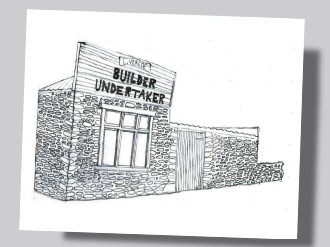
At the back of the lodge, and along the street, is the small stone shop of L.Vercoe. He was the local builder as well as the undertaker. It was common in those days to combine these occupations. An earlier builder, Thomas Wilkinson, who worked on many buildings in Clyde, had the hospital contract to bury paupers.
The original one-storey wooden and canvas building on this site opened in 1863 as the Dunstan Hotel. In 1899 its replacement was a grand double-storied building – the first of its kind in Central Otago. It was built for Harry Hart, of Lawrence, and Mr Alderdice of Dunedin, by Thomas Wilkinson, a local builder, John Holloway, a stone mason of Clyde, Albert Fountain, and apprentice carpenter Hugh Naylor.
Cobb & Co coaches on their daily run from Dunedin to Cromwell pulled in at the Dunstan. In winter with below zero temperatures, “mine host” would offer Scotch to the men and hot tea to the ladies. The hotel retained the 1863
underground cellar and also used it as a marshalling area for the hotel’s team of “dancing girls” who emerged from the cellar into the main bar to give their performances. The day when it ceased trading as a hotel in 1937 patrons rode
their horses up the stairs, around the upper gallery and down again. It became a private residence and in the 1930s was converted into flats. It has since been beautifully and faithfully restored. Renamed Dunstan House, it is now open
for accommodation.
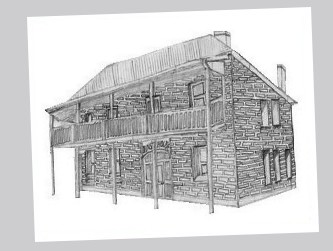
The Bank of New Zealand was an early arrival on the Central Otago gold mining sites. A year after the bank was founded in 1861 a small wooden building housing the Goldfields agency, under the management of Joseph Skinner, opened on October 1, 1862, the same day as a BNZ branch opened in London. It closed on July 13, 1869, but reopened as a BNZ Branch in April, 1901. The building you see today is relatively new - it was built of reinforced concrete in 1952 but in a style sympathetic to the older buildings in the street. It closed in 1986 and was sold in December that year. The wings on either side of the main building were added in the 1990s.
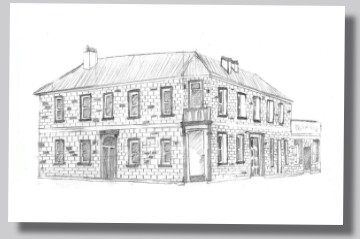
The hotel is built on a site which was occupied by one of Clyde’s earliest tent hotels, the Hotel United States. It was built by the Buckingham family who shortly after moved to Arrowtown when gold was found there in 1862. In 1868 Mr Cox built a handsome wooden hotel on the site and named it the Port Phillip. It was destroyed by fire in 1903 but was rebuilt in stone and renamed the Commercial Hotel. A few days later a fire gutted the interior but because the town was booming and the stone structure was undamaged, it was rebuilt. Over the years the hotel changed hands many times but its exterior remained the same. In the 1960s, an impressive stone building next door, Bell’s Biscuit Factory, was demolished and replaced by a concrete block building as a new bar. In 1987 when the main street was used as a set for the film Illustrious Energy the stone and mud brick facades were added, using materials from the old part of Cromwell that was to be flooded by Lake Dunstan.
11. Benjamin Naylor’s Store (Olivers) 1870
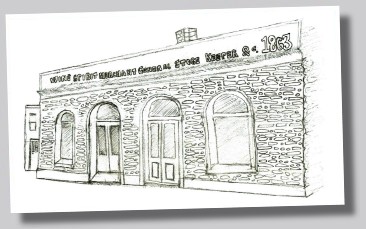
This large complex has survived almost intact. In 1862 Benjamin Naylor arrived in Upper Dunstan bringing a wagon load of supplies and on this site, erected a tent as a store for the thousands of miners flooding into Clyde.
He was born at Worksop, Nottinghamshire, England, in 1830 and trained as a blacksmith. In 1851 he sailed to the Victorian gold fields in Australia. He was lured to Otago when Gabriel Read discovered the huge gold field in Lawrence in 1861 where he set up a store before shifting to the Dunstan gold fields.
In 1863 the tent store was replaced by a wood and corrugated iron building, the Victoria Store, with accommodation attached. The existing stone building dates from 1870. Eventually Naylor purchased the land from the store to the corner (Naylor Street) and built stables, coach sheds, a smoke house, a large store for timber and iron and a gracious home. The home, complete with conservatory, servants quarters and a large underground coal and food storage cellar is still in its original condition - apart from the front of the house which was altered in 1929. The walls surrounding the property were built from stones salvaged from derelict buildings.
Naylor served four years as Mayor of the Clyde Borough and often entertained the then New Zealand Prime Minister, Richard Seddon (King Dick).
In 1925 the property was sold to Joseph and Sarah Davidson who partitioned the store with half remaining as a general store and the other as a drapery. The property remained in the Davidson family until the mid- 1960s. In 1977 it was bought by Fleur Sullivan and re-opened as Olivers Restaurant and Lodge. During the restoration many old treasures were found, including the day books dating back to 1864.
Matau Street
12. The Stone Building in Matau Street
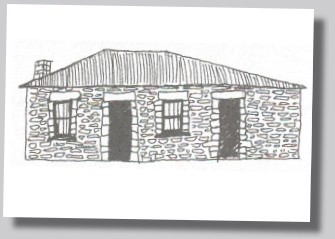
The building has been the subject of considerable research but its origins are still not known. It is possible it dates from the mid-to-late-1860s and was part of the property acquired by the Superintendent of Otago in 1869 for the “advancement of education”. The original Clyde School was behind this building on the main street before the school was shifted to its present site in Blyth St. In 1872 it was sold to John Cox, a hotel keeper. It is whispered it might have been used as a brothel. It was rented to a family in 1930 and by the 1950s it was owned by Rex Stevens whose father once owned the Dunstan Times. He used it as a storeroom but remembers the building being used for boxing lessons, as a honeymoon suite, and a mortuary. The interior of the building was greatly altered in 1987 to represent an opium den for the movie Illustrious Energy. It is today owned by the Alexandra Bridge Club which, along with Promote Dunstan, is working to restore and preserve the building.
13. St Michael's Anglican Church
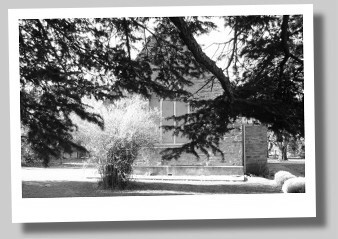
The church was built in 1877 using local stone. A traditional English church in design, its interior woodwork was crafted by Charles Hueston, grandfather of the Waldron family. The ceiling is arch-braced dark wood, the large east and west windows have tracery tops. The small windows are early English lancet. The much older stone wall fronting the church originally surrounded an earlier wooden church.
The Maori called the river Mata-au which means eddy or current across an expanse of water. The early miners knew it as the Molyneux, named by Captain Cook after his sailing master.
Today it is the Clutha. This beautiful but treacherous river with its powerful currents has claimed many lives and it was both respected and feared by the miners. The river was originally crossed by a punt operated by Robert Phinn, just above Muttontown Gully, three kilometres from Clyde on the state highway to Alexandra.
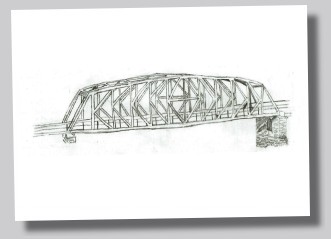
The first bridge was built in 1876 for £6500 ($13,000) by the Clyde Corporation, which charged a toll to cross it. That was abolished in 1878 when it was bought by the newly-formed Vincent County Council. That same year massive flooding swept away the wooden structure leaving just the cables and stone piers. Rebuilding took three years and the new bridge, which was higher, opened in June 1881. It was replaced in 1934 by a steel-arched bridge. The cable pillars were removed and the bridge rests on the original stone piers.
Blyth Street
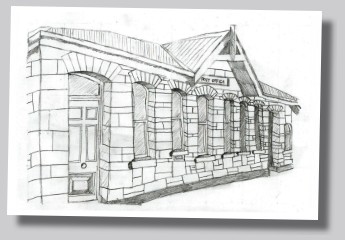
The original Post Office was a calico tent, then corrugated iron and wood. The Post office you see today was built in 1865 featuring fine stone work by a Cromwell mason, Mr Gair. The first telegraph line was operating in October, 1874. The building was extended in 1907 to house mail boxes and a telephone exchange. Seven telephones were installed in 1909.
The Postmaster’s residence, also in stone, complements the Post Office. This area was the hub of the town from the 1860s to the end of the century and was known as “The Camp”.
16. Council Chambers / Clyde Historical Museum
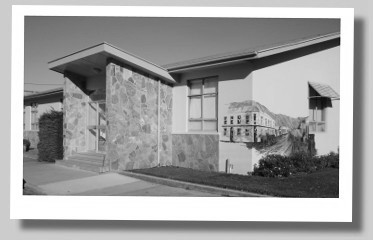
Across the road is a 1965 building that served as the headquarters of the Vincent County Council until 1989 when it became part of the Central Otago District Council. It was built on the site of the first Chambers, an elegant stone
building which opened in March, 1879. Sadly, it was replaced by an out-of-character modern building in the days when the preservation of old buildings was of no great importance. The Clyde Historical Museum took over the building in the early 1990s. Staffed by volunteers, it is open from September
to April, Tuesday to Sunday, from 2p.m.
Next door is the old Magistrate’s and Warden’s Court House. Built of stone in
1864, it replaced the original canvas and timber-framed construction lined with paper destroyed during a wind storm in 1863. The court house was also the administration headquarters of the Dunstan gold rush and contained the offices of Vincent Pyke, Commissioner of the Goldfields, and Major Keddell, commander of the mounted police. It is now a private residence.
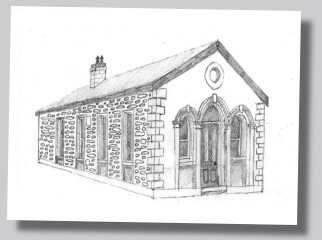
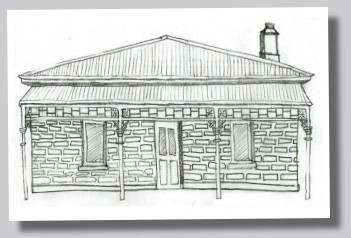
The stone house next to the Court House was built in the 1870s for the Sergeant of Police. At the time there was a stone jail to the left of this building and an office beside the residence. From here to the school further along the road, were housed up to 15 mounted troopers who policed the goldfields and acted as escorts for the gold coach to Dunedin and to many important visitors.
Fraser Street
19. St Dunstan's Catholic Church 1903
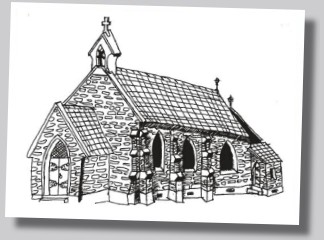
The church was built in 1903 by a local builder and mason, Thos Wilkinson and John Holloway & Associates. It replaced an 1864 church, St Mary’s, which was destroyed by a wind storm. Mass was heard in the old stone school on the main street until the new church was finished. It is a fine example of early English Gothic, roofed with Marseilles tiles. It was restored and rededicated on October 18, 1989.
20. St Mungo's Union Church 1894
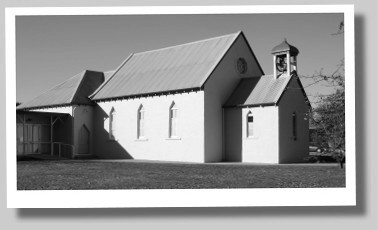
Directly across the road is St Mungo’s which today serves Clyde and surrounding area. It was built by the district’s Presbyterians in 1894 of wood but was roughcast in the 1950s and redecorated inside. In 1970 the Methodists joined the Presbyterians to create the Union Church.
21. Benjamin Naylor's House 1884
Almost across the road stands a solid house of local stone. It was built in 1884 by Albert Otago Fountain and J. Noone, stonemason, for Benjamin Naylor, a cousin of the Benjamin Naylor of the Victoria Store. Born in 1851, he came from America in 1874 to assist his older cousin and were known locally as “Young Ben” and “Old Ben”. In the 1890s Young Ben set up his own business, a general store on the corner, which is now the Four Square Store. The home still belongs to the Naylor family.
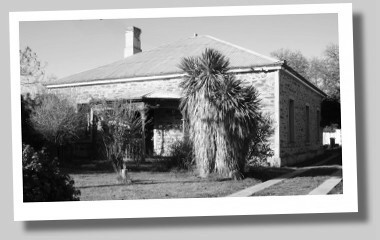
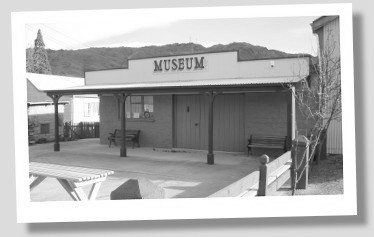
From the 1930s until 1976 this was a business started by an English couple, Mr and Mrs Berbery, who dried and packed herbs for culinary use. They also collected wild briar hips which were sent to Dunedin for rose hip syrup. The couple was later joined by another Englishwoman, Miss Annie Radcliffe, who eventually took over and expanded the business which was registered in 1948.
The factory processed about 18,000 kilograms of wild thyme, along with quantities of sage, mint and other herbs which were sent throughout New Zealand. Its trade mark “Briar” became known throughout the country. During the season, families and local residents would picnic in the hills and cut wild thyme which they sold to the factory. Thyme (thymus vulgaris) was introduced by the gold miners and has spread over the hills around the Clutha, Kawarau and Manuherikia Rivers.
By the 1970s increasing costs and competition forced its sale. But a buyer could not be found and it was offered to the Museum Committee of the Vincent County Council which took possession in January, 1977.
Much of the equipment is still in the museum and in working order. It is open from September to April, Tuesday to Sunday, from 2 p.m. Holden Cottage, the tiny stone building in the grounds, was rescued from the Cromwell Gorge before it was flooded when the Clyde Dam was completed.
To the right of the museum is Clyde’s original railway station. It opened with great fanfare in 1907 when the line finally reached Clyde. It is one of only three original stations in Central Otago that is still standing and is almost in its original condition both inside and out. The railway to Cromwell was closed with the Clyde Dam construction and in 1980 the railhead was shifted to where the Rail Trail is now based. The rail service into Central Otago closed in 1990. The station is now a museum run by the Stationary Steam Engine group and houses its superb collection of machinery, communications equipment and other memorabilia. The group, along with Promote Dunstan and the Central Otago District Council, is working on a restoration plan for the station.

Sunderland Street
Heading back down Fraser St to Sunderland St and towards the centre of Clyde, on the right stands a white cottage decorated with the iron lace of the Victorian era. In the 1870s this house was the home of Charles Henry Wong Gye who was born about 1839 in Taishan county in Guangdong, China. He left his homeland for the Victoria goldfields in Australia where he worked as a storekeeper.
He was well educated, fluent in English and, in 1869, he married Harriet Asquith of British stock, and they were to have 14 children. When the Chinese police interpreter’s job became vacant in Otago, Wong Gye successfully applied. He was made a special constable with responsibility for the Chinese miners and was first based in Lawrence then in Clyde. His job included checking on mining licences, interpreting legal cases involving Chinese and looking out for illegal gambling.
Wong Gye was dismissed in 1890 in a controversial move by the local police inspector and his job as constable-interpreter was dis-established. He stayed in Clyde working as a miner and gardener until his death in May, 1911. His children played a full part in Clyde’s business and social affairs and, like many Chinese-European marriages, had little contact with Chinese life. His descendants still live in the area.
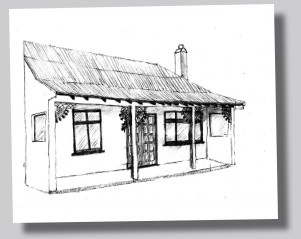
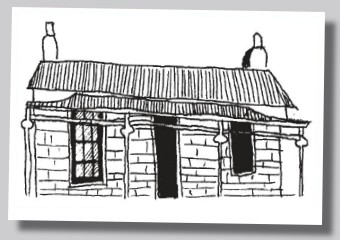
Opposite is a very old stone house, perhaps the earliest one built in the town. Mr Tyrell, a clerk of the Court, built it for his family in the 1860s. It retains its original structure but has been added to at the back and the left side of the house.
Next door is a stone house of similar vintage built by Anthony Brough, the first solicitor to practise in Clyde. Originally the property was several small allotments surveyed as tent sites during the gold rush which were amalgamated into a large section. The house was later occupied by Mr Brough’s successors, F.W. Wilson, and then Robert Gilkison, the author of Early Days in Central Otago who added the separate two-roomed stone building to the left, as a nursery. In 1973 the house was bought by Christina McDonald. Born in Invercargill in 1911 she trained as a nurse at Dunedin Public Hospital and became one of the first three nursing sisters attached to the NZ Naval Hospital at Devonport, Auckland. She served with ‘J’ Force in Japan from 1946 and was twice honoured in her career with the Red Cross equivalents of the MBE and the OBE. She was also an honorary nursing sister to the Queen.